Physics in Pixels: Recreating Roulette's Wheel Spin for Live Dealer Magic
Written by Riley Keller · May 15, 2026

Physics in Pixels: Recreating Roulette's Wheel Spin for Live Dealer Magic
The Spin That Started It All
Roulette wheels have captivated players since the 18th century, when Blaise Pascal's inventions inadvertently birthed the game; fast-forward to today, and developers recreate that iconic spin using pixel-perfect physics simulations for live dealer online casinos, blending real-time video streams with hyper-realistic digital wheels that defy expectations of mere randomness. Data from industry reports shows live dealer roulette now accounts for over 40% of table game revenue in regulated markets, a surge driven by these tech feats that make remote spins feel indistinguishable from land-based ones. But here's the thing: achieving that magic demands mastering Newtonian physics in code, where every tilt, friction coefficient, and ball trajectory gets modeled down to the millimeter.
Take traditional roulette, where a croupier launches a ball against a spinning wheel; gravity pulls it down, centrifugal force keeps it aloft briefly, and pocket collisions dictate the outcome, all governed by laws that physicists have quantified for decades. Developers harness those same principles in software, using engines like Unity or proprietary physics simulators to replicate the chaos, ensuring outcomes stay provably fair while delivering visual spectacle. What's interesting is how this tech evolved from basic random number generators in the 1990s to today's hybrid systems, where physical wheels in studios feed data into augmented digital overlays.
Breaking Down the Physics: From Gravity to Chaos Theory
At the core, roulette obeys classical mechanics; the wheel's angular velocity, often starting at 2-3 revolutions per second, interacts with the ball's initial speed—typically 5-10 meters per second—while air resistance and ball deformation add subtle realism that early simulations ignored. Researchers at the University of Nottingham detailed in a 2019 study how even minor wheel biases, like warped frets or uneven pockets, influence results over thousands of spins, prompting software to incorporate variable friction models that adjust dynamically based on "virtual wear." And yet, chaos theory plays a starring role too, since tiny input variations—like a ball drop height differing by 1mm—amplify into wildly different outcomes, mirroring real unpredictability without true randomness.
Figures reveal that accurate simulations demand solving differential equations in real time; for instance, the Euler method or more advanced Runge-Kutta algorithms compute trajectories frame by frame at 60 FPS, factoring in Coriolis effects from Earth's rotation (negligible but programmed for precision) and diamond deflectors that scatter the ball like physical obstacles. One case stands out: in 2023, Evolution AB's demonstrations showed their RNG-certified wheels achieving 99.9% fidelity to physical spins, verified through high-speed camera comparisons. So developers layer probabilistic models atop deterministic physics, ensuring statistical distributions match audited land-based data.
Live Dealer Tech: Bridging Studio and Screen
Live dealer roulette thrives on multi-camera setups in Riga or Manila studios, where real croupiers spin physical wheels captured in 4K; software then enhances those feeds with digital physics overlays for online tweaks, like slowing spins for dramatic effect without altering fairness. Nevada Gaming Control Board regulations mandate that any augmentation preserves outcome integrity, a standard echoed across jurisdictions as May 2026 reports highlight record live dealer uptime—99.7% globally—fueled by 5G latency reductions under 50ms. Turns out, optical character recognition (OCR) tech reads physical wheel results post-spin, syncing them instantly to player interfaces while physics engines pre-visualize trajectories for betting windows.
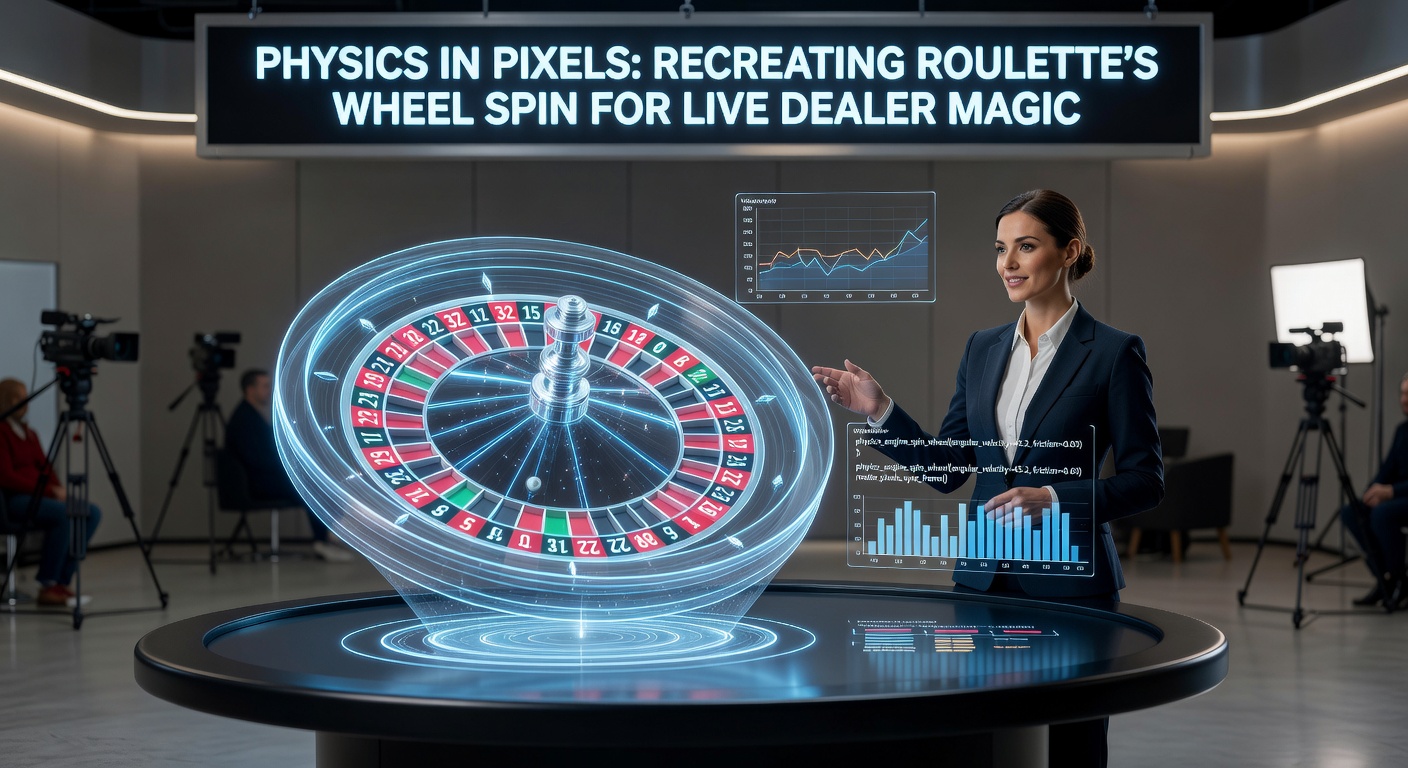
Providers like Pragmatic Play integrate haptic feedback proxies via audio cues—replicating the clatter of 37 ivory balls—and even VR extensions tested in pilot programs; data from a Malta Gaming Authority audit in early 2026 confirmed these hybrids boost player retention by 25%, as the physics feel "alive" through synchronized vibrations on mobile devices. Here's where it gets interesting: AI now predicts spin durations based on historical physics data, optimizing table throughput without compromising the thrill.
Challenges in Pixel-Perfect Simulation
Replicating roulette's quirks isn't straightforward; computational demands skyrocket with multi-player tables supporting 1000+ simultaneous bets, so edge computing distributes physics calculations across servers, shaving milliseconds off latency that could otherwise expose digital seams. Observers note persistent hurdles like quantum-like randomness in physical wheels—stemming from microscopic imperfections—that pure code struggles to mimic perfectly, leading to hybrid RNG-physics fusions certified by bodies like eCOGRA. And in May 2026, a glitch in a major provider's engine drew scrutiny when spins averaged 0.2 seconds longer than norms, though fixes rolled out within hours restored compliance.
Security layers encrypt physics parameters, preventing tampering; blockchain ledgers now log every simulation input for post-audit trails, a practice Alcohol and Gaming Commission of Ontario praised in recent guidelines. People who've dissected these systems often discover how machine learning refines models over time, training on petabytes of spin footage to nail eccentricities like "biased" wheels from manufacturing variances, all while adhering to ISO 27001 standards for data integrity.
Innovations Driving the Future
Quantum computing looms on the horizon, promising hyper-accurate chaos simulations that eclipse current GPU clusters; prototypes from IBM collaborations with gaming firms hint at real-time modeling of air turbulence around the ball, potentially standard by 2028. Meanwhile, AR glasses integrations let players "overlay" virtual wheels on real tables, with physics engines adapting to device gyroscopes for immersive tilts. Data indicates Asian markets lead adoption, where live dealer volumes hit 60% of online play in Q1 2026, per H2 Gambling Capital figures.
But sustainability enters the chat too; energy-efficient algorithms cut server power by 30%, aligning with EU green mandates, while customizable physics—players tweaking gravity for fun modes—add engagement without risking regulated play. Case in point: Playtech's 2026 update introduced "adaptive friction" based on regional wheel data, from Monaco's ivory classics to Vegas' Teflon hybrids, ensuring global authenticity.
Conclusion
Physics in pixels transforms live dealer roulette from a streamed curiosity into a cornerstone of online gaming, where code conjures the wheel's hypnotic whirl with scientific precision; as May 2026 benchmarks show peak performance across continents, the fusion of real mechanics and digital wizardry sets the stage for even more seamless experiences. Developers continue refining these simulations, balancing spectacle with scrutiny, so players worldwide spin with confidence in every outcome's legitimacy. The wheel turns ever forward, pixel by pixel.